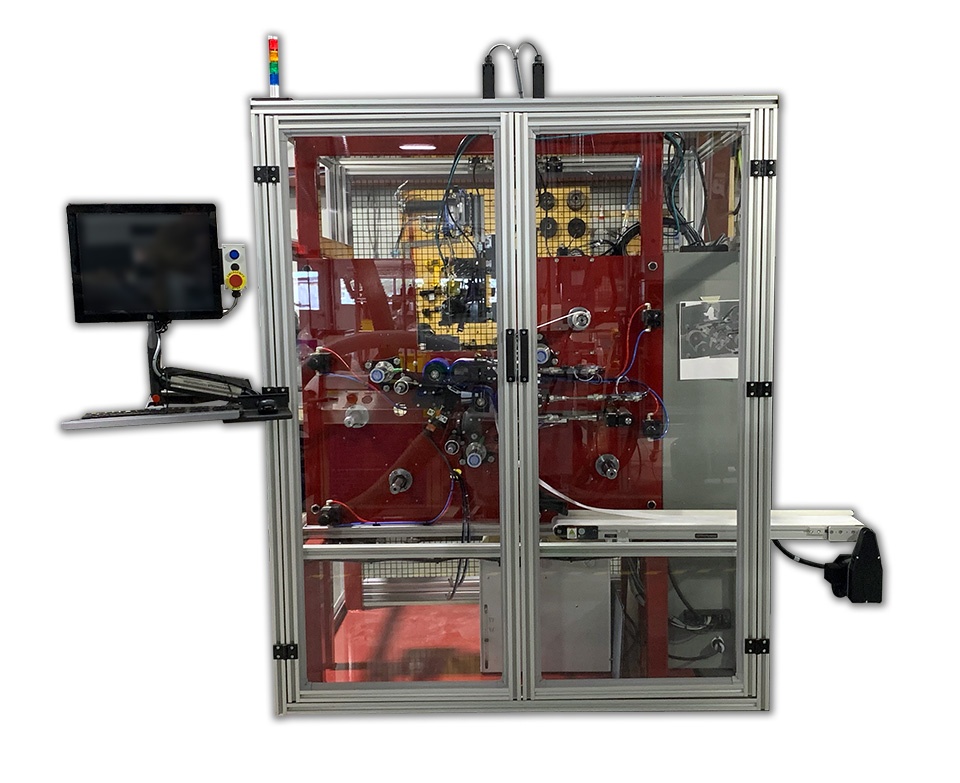
EPS is now the exclusive North American distributor for the Xaar Versatex Printbar

We have written in the past about the importance of finding the bottleneck and how seconds matter in any production process.  Time truly is money, and today we would like to walk through a sample ROI calculation one typically encounters when considering moving from an analog method of product-decoration such as pad printing, silk-screening, or in-mold labelling to digital inkjet product-decoration.

The numbers we will use are merely illustrative.  Thankfully, the price of the part to be decorated is irrelevant.  All that matters is the opportunity cost—the cost of the next-best alternative, which can be assumed to be the current method of product decoration.  Since we also build pad print machines, we will examine this alternative method of product decoration most closely, but screen-printing costs will also be considered.

Let’s start with a few assumptions.  Assume that the profit from each unit using your current method of product-marking is $1.  Assume further that your unit profit using a high-speed single pass inkjet printer is three dollars.

These are reasonable assumptions for several reasons.  First of all, there is little to no ink waste in industrial inkjet printing, as the ink system recirculates ink that is not used, and there is no waste from leftover ink in ink cups as there is with pad printing.  There are also no clichés to purchase or make and store.

So unit costs can be lower.  But what about the revenue side? The second reason why it is reasonable to assume higher unit profit is that industrial inkjet printers can produce premium effects, whether through greyscale printing to produce subtle gradients, or using High Laydown Technology to produce a pleasing tactile finish.  Industrial inkjet printers are also capable of variable data printing, enabling individual customization at a mass scale and justifying a premium price.  Finally, industrial inkjet printers can use variable data printing capabilities to ensure the authenticity and purity of products through batch-coding and other anti-counterfeiting methods.  This can not only cut down on costs from product-diversion and lost sales, but guarantees of authenticity further justify a price premium.

Now imagine being able to do all that, but faster.  Assume that using current methods, a facility is able to produce 800 units per hour.  This facility is considering investing in a single pass inkjet printer, which will be capable of decorating 1200 parts per hour.  What would be the return on investment?

Using current machinery, the company is generating $800 in profit per hour.  With a throughput of roughly 18 inches per second, our XD70 single pass inkjet printer is capable of generating $3600 in profit per hour in this scenario.  In a forty-hour work week, the single pass machine would generate $112,000 in additional profit every week, or $5.6 million annually.

There are other sources of positive return as well.  As mentioned, there are no clichés, pads, or ink cups to store, so less warehouse space is necessary.  There may be some salvage value in existing machinery.  Labor costs associated with making clichés (or buying them) are also foregone.  Finally, with minimal automation such as part load/unload, a single operator could operate more than one machine, something that is harder to do with multiple pad print or screen print machines.

There are of course many other challenges to industrial inkjet product decoration, with part topology and substrate composition being the chief ones.  With  new polymers being invented each day, getting ink to stick to parts—and stick where you want it—while they move quickly past a print array remains a technical challenge, as variable drop sizes have different trajectories, some parts have nooks and crannies that are hard to hit with ink, and even the movement of the part can create wind turbulence that affects droplet trajectory.

That is why it always pays to partner with a company with a proven track record of building product-marking machines, a company that knows inks, substrates, and innovative part-handling solutions.  (You can read more about choosing the right industrial inkjet printer here.)  But many customers are surprised at how quickly even complex high-speed single pass printers can pay for themselves.

Seconds matter!

Want to learn more about how seconds matter? Drop us a line!

Fields marked with an asterisk are required.
This will enable us to direct your inquiry to the appropriate Sales Engineer.
Click or drag files to this area to upload.You can upload up to 3 files.
Upload an image file (optional)
Note: Under no circumstances will we sell, share or otherwise distribute your data outside EPS.

Manufacturers in the US have been re-examining their global supply chains for years, and the Covid-19 pandemic only accelerated this trend. As long ago as 2018, Industry Week reported that reshowing had increased 38 percent year-over-year due to rising foreign wages and increased tariffs. In 2020, factory shutdowns, port closures, and shipping disruptions caused by the Ever Given in the Suez Canal all contributed to companies’ desire to shorten supply chains and bring some secondary operations such as late-stage product-marking and -decoration in-house.

Among our customers old and new, we have seen the restoring phenomenon up close. Indeed, for many companies, we have helped with the process. By bringing digital product-decoration in-house, companies find that they can keep leaner inventories while increasing their manufacturing flexibility, as late-stage decoration can take place after the product is already sold. With virtually no make-ready to worry about, since there are no screens, clichés, or inks to change over in digital product-decoration, machine downtime is dramatically reduced, and extremely short runs become economical.

ROI is Key

One customer of ours bought a highly-complex pad printing system, with optical image alignment, an elliptical conveyor, 18 pads, and inline post-cure. The total price of the equipment approached three-quarters of a million dollars, but the customer reports that the machine paid for itself in twelve days of production.

As with any go/no-go decision regarding capital expenditures, when purchasing product-marking equipment to bring that process in-house, the payback period must be a reasonable one. Many of our customers are astonished when we demonstrate how quickly an investment in product-marking equipment can pay for itself, whether it is a digital process or an analog one. One customer of ours bought a highly-complex pad printing system, with optical image alignment, an elliptical conveyor, 18 pads, and inline post-cure. The total price of the equipment approached three-quarters of a million dollars, but the customer reports that the machine paid for itself in twelve days of production. Currently, we are building a second machine for this company, with two more slated for manufacture in the coming year.

This company has approached Engineered Printing Solutions again and again for product-marking solutions because they know that we build machines that not only get the job done, but that also allow companies to offer shorter runs, more variety, and less time to market—all of which goes directly to their bottom line. Interestingly, the company mentioned above has made the conversion to digital; the next few machines we are building for them will be industrial inkjet.

Engineered Printing Solutions Can Help You Find That ROI

Is your company considering bringing product-decoration in-house? Or perhaps you already decorate parts and are looking for a way to increase the breadth of your product offering, whether by increasing the number of SKUs you offer, or else by offering shorter runs than your competition. Either way, drop us a line—you might be astonished at how quickly that investment can pay for itself.

Fields marked with an asterisk are required.
This will enable us to direct your inquiry to the appropriate Sales Engineer.
Click or drag files to this area to upload.You can upload up to 3 files.
Upload an image file (optional)
Note: Under no circumstances will we sell, share or otherwise distribute your data outside EPS.

EPS’ Midwest Sales Engineer Ken Tyler recently sat down with Deborah Corn and Pat McGrew of The Print Report to talk a little bit about direct-to-object part-decoration.

Today on The Print Report: Direct-to-Object, is it becoming a bigger thing? And how do you actually make it happen?  It takes the right skills and the right innovation to design and manage meaningful print marketing solutions. Welcome to Podcasts from the Printerverse, where we explore all facets of print and marketing creates stellar communications and sales opportunities for business and success. Now here’s your host: the intergalactic ambassador from the Printerverse.  Listen long and prosper!

Schedule your own consultation with one of our Sales Engineers:

Fields marked with an asterisk are required.
This will enable us to direct your inquiry to the appropriate Sales Engineer.
Click or drag files to this area to upload.You can upload up to 3 files.
Upload an image file (optional)
Note: Under no circumstances will we sell, share or otherwise distribute your data outside EPS.

On March 13, 2021. the Manchester Machine Makers robotics team was recognized with First Place for the Think Award at the Vermont State Championships for FIRST Tech Challenge.     About 30 teams competed at the event, coming from across Vermont, and from several states beyond (teams list:  Vermont FTC Registration | The University of Vermont (uvm.edu))

The Think Award is one of seven judged awards that were presented at the event, and primarily focuses on the team’s use of math and science to drive its engineering design process (I’m including a complete description of the award below).   Math and science-driven design is a strong suit for our team — at last year’s Vermont State Championship (the team’s rookie year), we were recognized with second place for the same award.

This year’s team members are Charlotte Ruley and Taylor Jarvis (both 11th grade at BBA), Isaac Vernon (9th grade at BBA), Aleks Rutins (8th grade at The Dorset School), and Jason Giedja (7th grade at Long Trail School).  The team’s coaches this year are Mike Cole and Meg Ruley, and its mentors are Bob Ruley and Patty Rutins.

The team is a chartered 4-H Club by UVM Extension, and recruits team members in grades 7-12 from all schools in the Manchester area.  They are always open to having new members join the team.  Engineered is proud to sponsor the makers of tomorrow.

Here’s how you can help the Manchester Machine Makers:

YouTube player

FIRST Tech Challenge

Think Award 

Removing engineering obstacles through creative thinking. 

This judged award is given to the Team that best reflects the journey the Team took as they experienced the engineering design process during the build season. The engineering content within the portfolio is the key reference for Judges to help identify the most deserving Team. The Team’s engineering content must focus on the design and build stage of the Team’s Robot.

Additional detailed information that is helpful for the Judges would be in the team’s Engineering Notebook and would include descriptions of the underlying science and mathematics of the Robot design and game strategies, the designs, redesigns, successes, and opportunities for improvement. A Team is not a candidate for this award if their portfolio does not include engineering content.

Required criteria for the Think Award: 

  • Team shows respect and Gracious Professionalism® to everyone they meet at a FIRST Tech Challenge event.
  • Engineering portfolio must have engineering content. The engineering content could include entries describing examples of the underlying science, mathematics, and game strategies in a summary fashion.
  • The engineering portfolio must provide examples that show the Team has a clear understanding of the engineering design process including examples of lessons learned.
  • The portfolio should inspire the judges to want to see the detailed engineering content in the engineering notebook.
  • Portfolio format is less important but enables the judges to understand the team’s design maturity, organizational capabilities and overall team structure.
  • Portfolio could reference specific experiences and lessons learned but should capture the summary of the current status of the Team and their robot design.
  • Portfolio could also summarize experiences and lessons learned from outreach with concise tables of outcomes

Strongly suggested criteria for the Think Award: 

  • Teams should flag or provide a reference to 6 to 8 pages of the engineering notebook(s) to support the engineering content included in the engineering portfolio.
  • Engineering portfolio could summarize how the Team acquired new mentors or acquired new knowledge and expertise from their mentors.
  • Engineering portfolio could contain summary of overall Team plan.
  • Engineering portfolio could contain information about the plans to develop skills for Team members.

America has a throughput problem.  How to stick over 600 million doses of COVID-19 vaccine into arms as quickly as possible?

We have written in the past about the logistical challenges of administering the COVID-19 vaccine to the US population—the challenges of manufacturing the vaccines and distributing them.  This is a classic throughput problem, so let’s take the same approach to the problem as we do when trying to shave seconds off of a print cycle. (See “Seconds Matter.”)  Simply put: find the bottleneck.

Find The Bottleneck

Production bottlenecks can have you singing the blues too.

On Friday, February 12, the US Food and Drug Administration (FDA) found and removed one such bottleneck in the supply-chain for the COVID-19 vaccine.  In this instance, the bottleneck was quite literally the bottle, or rather, the number of doses per vial.  The FDA granted approval for Moderna to package 14 doses of its COVID-19 vaccine into each vial instead of ten.  Since Moderna supplies half of all vaccines in the US, this simple ruling increased the national vaccine supply by 20 percent, without requiring any changes at any stage of the supply chain.  No new lines were added; no new tooling was required to accommodate larger vials.

The objective in bottleneck-hunting is increased efficiency, as one could easily double throughput by doubling inputs, from raw materials to labor and machinery.  But this also doubles cost, and companies like the rest of us live in a world of constraints, whether they be financial or simply factory floor space.  Finding and removing the bottleneck should initially result in increased output using the same level of inputs.

This is the goal of our Sales Engineers whenever a customer brings a direct-to-shape printing challenge to us and asks, “How can I do this faster?”  Frequently, as we have seen, precious seconds can be found in upstream activities such as part-loading.  (See one such solution here.)  Alternatively, perhaps it is the pretreatment subroutine.  Part-unloading activities may also be the bottleneck.

With our single pass inkjet printers and automated pad printers, we sell machines that can mark thousands of parts per hour.  Generally the bottleneck lies elsewhere.  That’s why we are so much more than a manufacturer of industrial printers.  We also offer a complete line of ancillary products such as inline pretreatment, mechanical aggregators such as waterfall hoppers and racetrack feeders, servo-controlled fixtures, and robotic load/unload.

Have you got a throughput problem? Drop us a line today, and one of our Sales Engineers would be happy to discuss it with you.  At Engineered Printing Solutions, we have helped companies in industries as diverse as automotive, medical device and drinkware find and create value and develop new products.  Let us do the same for you.

Fields marked with an asterisk are required.
This will enable us to direct your inquiry to the appropriate Sales Engineer.
Click or drag files to this area to upload.You can upload up to 3 files.
Upload an image file (optional)
Note: Under no circumstances will we sell, share or otherwise distribute your data outside EPS.

Case Study: Hodges Badge Company Converts to Cold-Foil PrintingFor over 100 years, Hodges Badge Company has been a family-owned and operated business selling awards, ribbons, and rosettes for every occasion, from dog shows to academic and sporting events to corporate awards. Recently, the company approached Engineered Printing Solutions about making the leap from hot-foil stamping production to cold-foil printing. We designed and built a machine for the company, and they haven’t looked back since.

Case Study: Hodges Badge Company Converts to Cold-Foil Printing

Rick Hodges, President, Hodges Badge Company

We have written in the past about the advantages of cold-foil printing over hot-foil stamping, but Rick Hodges, president of the company, summarized the benefits in a recent phone call. “With no dies to make, our lead times went from two days to two hours”. In addition, the quality of their designs went up, as the company was able to produce finer lines than they could with hot-stamping, which sometimes produces “bridging” between two lines when excess foil is applied. This is not a problem with cold-foil printing, said Hodges. Hodges also cited the cost-savings of not having to warehouse dies for future use as an additional benefit of going the cold-foil printing route.

Converting from traditional production methods to cutting-edge cold-foil printing is not without its challenges however, warned Hodges. “There is a bit of a learning curve, as digital inkjet printing requires a completely different skillset than traditional tool-and-die manufacturing,” he noted. Hodges credited EPS’ after-sales service and support for getting the badge company up to speed.

And speed is what attracted Hodges to the idea of cold-foil printing in the first place. The speed-to-market advantage of cold-foil printed products over conventionally-produced products means that there are whole new markets that Hodges Badge Company can serve that simply aren’t economically feasible using conventional methods with their tooling costs. Variable-data products and runs-of-one become viable options using cold-foil printing.

Hodges intends to hold on to its first-mover advantage when it comes to cold-foil printing. “None of my competition can match the quality, variety, and speed-to-market of our products,” he said, and he doesn’t foresee that changing any time soon.

Do you need award ribbons, medals, trophies, or other memorabilia? Contact Hodges Badge Company today. And to learn more about cold-foil printing, drop us a line!

Fields marked with an asterisk are required.
This will enable us to direct your inquiry to the appropriate Sales Engineer.
Click or drag files to this area to upload.You can upload up to 3 files.
Upload an image file (optional)
Note: Under no circumstances will we sell, share or otherwise distribute your data outside EPS.
Case Study: Hodges Badge Company Converts to Cold-Foil Printing

This industrial inkjet printer jets UV-curable adhesive that instantly bonds the cold foil to the substrate.

singlepass-printed mousetrapsMitec Enginy, a Catalan company specializing in the automation of industrial production processes, has collaborated with Engineered Printing Solutions to produce a digital ink jet printing machine to be integrated into their automation. Engineered Printing Solutions’ XD-70 printer will be used to print on wood blocks, giving their customers the quality and flexibility they are looking for.

Mitec chose Engineered Printing Solutions because of our knowledge of digital printing, experience in the industry, and the quality of our machines. Mitec CEO Albert Gratacos said “Engineered Printing Solutions is the unique company that can produce a high speed digital ink jet system and tailor it to our specific needs.” We look forward to our continued work with Mitec Enginy!

Watch these mousetraps being printed at right. You can read more about our collaboration here and here.

Want to find out more about industrial inkjet printing machines? Drop us a line!

Fields marked with an asterisk are required.
This will enable us to direct your inquiry to the appropriate Sales Engineer.
Click or drag files to this area to upload.You can upload up to 3 files.
Upload an image file (optional)
Note: Under no circumstances will we sell, share or otherwise distribute your data outside EPS.

Although making the leap into digital inkjet product decoration can be a daunting challenge, there are many reasons for doing so. Despite having a higher upfront capital cost, on average, as compared to traditional analog methods of product decoration, industrial inkjet printers offer many advantages over other methods. Below are six of the top reasons for converting to digital.

1. Industrial Inkjet Printers Offer “Contact-less” Printing For Delicate Substrates

Analog methods of product-decoration such as pad printing press the ink onto the part. Delicate parts such as light bulbs or Christmas ornaments do not lend themselves to such methods. With digital inkjet printers, there is no actual contact with the part, as the ink is jetted from as much as 10 mm away. In addition, all of our industrial inkjet printers use UV-curable inks. After receiving the ink, the part passes under an LED lamp and is instantly cured by UV light, without heat.

2. Industrial Inkjet Printers Enable Quick Changeovers

To set up a pad print job, you must first create a cliché with the image to be transferred to the part. Additionally, pad print machines use spot colors, so the ink must be mixed and loaded into the ink cup.

With industrial inkjet machines, there is no cliché, as ink is jetted direct-to-object. In most cases, there is no ink to change out as industrial inkjet machinery uses the process colors of cyan, magenta, yellow, and black.

3. Industrial inkjet Printers Enable Variable Data

Because the image is digital and there are no clichés, industrial inkjet printers are ideal for printing sequential serial numbers on otherwise-static artwork. So, for example, you could print a 10,000-unit run with identical branding and product information but with each one having a unique serial number.

This leads to perhaps the single-biggest reason to convert to industrial inkjet printers for product decoration…

4. Industrial Inkjet Printers Make Short Runs Economical

Any time a machine is not running, it is costing its owner money. With analog methods of product decoration, the way to maximize overall equipment effectiveness is through minimizing changeovers and make-ready work generally, and maximizing run lengths.

With industrial inkjet printers, once the artfile has been stored in the printer, it can be recalled with a touch of a button, and there are no clichés, inks, or pads to change out. One-off production becomes a possibility. And with no ink or clichés to change out…

5. There Is Less Waste With Industrial Inkjet Printers

With pad print machinery, any unused ink in the ink cup is simply wasted. With industrial inkjet printers, the ink is constantly recirculated, and most parts can be decorated in high-resolution CMYK for mere pennies, depending on the size and complexity of the art to be printed.

6. Industrial inkjet Printers Facilitate Leaner Inventories

When printing direct-to-object with an industrial inkjet printer, there are no labels to keep in inventory. This saves precious floor-space in a factory. In addition, because short runs can be economical when using industrial inkjet machinery, many parts can be left in an unfinished state and decorated on-demand in just-in-time fashion. This can reduce the need to warehouse finished goods, again saving a company money.
Six Reasons To Convert to Digital Inkjet Product Marking

Click for free download.

There are many factors to consider when contemplating converting from analog to digital methods of product-decoration. (You can download our White Paper on the subject here: Investing In Digital Printing: 5 Factors To Evaluate) Industrial inkjet printers are not the solution for every print job or for every company. But despite a typically higher initial CapEx than with analog methods of product-decoration, inkjet printers can start saving money in myriad ways. We hope you enjoyed the six we’ve listed here.

Want to find out more about industrial inkjet printers?  Drop us a line!
Fields marked with an asterisk are required.
This will enable us to direct your inquiry to the appropriate Sales Engineer.
Click or drag files to this area to upload.You can upload up to 3 files.
Upload an image file (optional)
Note: Under no circumstances will we sell, share or otherwise distribute your data outside EPS.

How Do You Vaccinate 320 Million People Quickly?  The XRV Rotary Syringe Printer Can Help.After a terrible year in which so far over 260,000 Americans have succumbed to the novel coronavirus, and with millions more deaths worldwide, it appears as though there is light at the end of the tunnel. No fewer than three different vaccines are either in final stages of testing or are in the initial phases of being rolled out to patients.

It is estimated that “herd immunity” occurs when a minimum of 70 percent of the population is vaccinated, which will require two doses.  But just how do you quickly vaccinate 320 million Americans—twice each—in a short period of time?  Not only do vaccines take time to culture (you can’t cook a Three-Minute Egg in one minute simply by turning up the heat), but so too do all of the ancillary products take time to manufacture, products such as the syringes with which to administer the vaccine.

Six hundred and forty million doses means 640 million syringes.  How do you scale up and manufacture nearly three-quarters of a billion syringes as quickly as possible? In a word, automation.  As with so many manufacturing processes, the bottleneck activity in part-marking is usually the ancillary activities adjacent to the actual process of marking the part, with part loading and unloading being the frequent culprits.  For this reason, we have designed the XRV Rotary Syringe Printer for high-speed syringe marking.

YouTube player

With the XRV, the operator loads bulk syringes into a waterfall feeder that cascades into a vibratory bowl feeder.  As the parts revolve around the bowl feeder,  the syringes fall into a track and become aggregated in proper alignment for marking.  The track then loads a rotating table, which moves parts past a rotating drum that houses nine pads, each of which has picked up the image from the rotating cliché, in a manner similar to how offset presses transfer ink from one roller to another.  The rotating table moves the freshly-printed parts past a Hot Wind device to quickly cure the ink.  Once the part has cured, it is automatically offloaded for secondary activities such as filling, assembly, and packaging.

With fully-automated load and unload and continuous ink-loading capabilities, the XRV rotary syringe printer is ideal for long production runs—the kind of runs necessary to produce billions of doses of a vaccine.  If you are looking for ways to speed up your throughput or to dramatically scale up production, give us a call.  We manufacture product-marking machinery with custom automation for companies in every industry.  Let us help you Change The Way YOU PRINT.
Are you looking for high-speed, automated product-marking solutions for the medical device industryDrop us a line!

Fields marked with an asterisk are required.
This will enable us to direct your inquiry to the appropriate Sales Engineer.
Click or drag files to this area to upload.You can upload up to 3 files.
Upload an image file (optional)
Note: Under no circumstances will we sell, share or otherwise distribute your data outside EPS.
EPS Announces BottleJet 2.1 Cylindrical Inkjet Printer

New servo motor replaces step motor for increased repeatability and reliability.
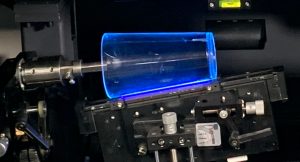
EPS Announces BottleJet 2.1 Cylindrical Inkjet PrinterEngineered Printing Solutions is pleased to announce a new version of its celebrated BottleJet Cylindrical Inkjet Printer—the BottleJet 2.1. Highlights include an improved lead screw motion motor, which is now servo-electric instead of a “step” motor for increased repeatability and reliability.  Other improvements include an improved bottle fixture, with additional guide rollers that can be installed and removed easily thanks to a quick-release latch.  We’ve also added a second mandrel with a shorter stem to accommodate larger bottles.
EPS Announces BottleJet 2.1 Cylindrical Inkjet Printer

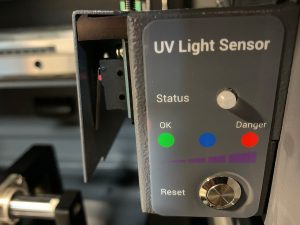
The UV sensor will prevent accidental curing of print heads.

Perhaps the single-biggest change over the previous model is the addition of a UV light sensor to prevent accidental damage to the print heads.  If the sensor detects the presence of UV light, the machine cancels the print job and returns to its home position.  In addition, there is a new lamp curtain window, which allows the operator to close off unused sections of the lamp that are not required for the curing process.  In previous designs you had to remove the second lamp when not in use and tape over any sections that were not being used in the remaining lamp.  A new angle-adjustment knob allows speedy adjustments of the curing lamp, where previously it was necessary to loosen a bolt to make adjustments.  This time-saving feature will be much-appreciated by operators.  Finally, the curing lamp can now be adjusted to have a negative angle, which means that the BottleJet can now print cylindrical objects with the print heads moving from the top of the part to the bottom without the need for reverse-tooling.

The BottleJet 2.1 has other upgrades as well.  A new red laser guide on the head carriage enables the operator to easily set the print origin on the part.  An improved method for stirring white inks even when the machine is off reduces startup time.  Even the firmware has been upgraded to power the new features of the BottleJet 2.1.

Want to find out more about the new BottleJet 2.1 cylindrical inkjet printer? Drop us a line!
Fields marked with an asterisk are required.
This will enable us to direct your inquiry to the appropriate Sales Engineer.
Click or drag files to this area to upload.You can upload up to 3 files.
Upload an image file (optional)
Note: Under no circumstances will we sell, share or otherwise distribute your data outside EPS.

The BottleJet 2.1 can produce photo-quality images in under a minute.