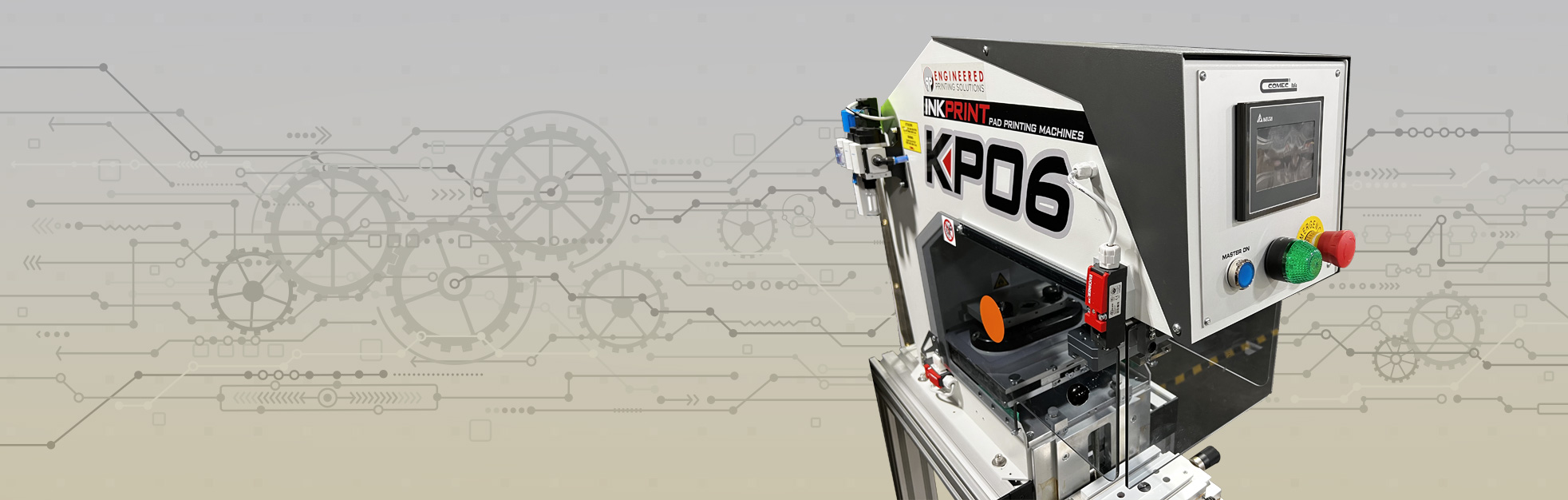
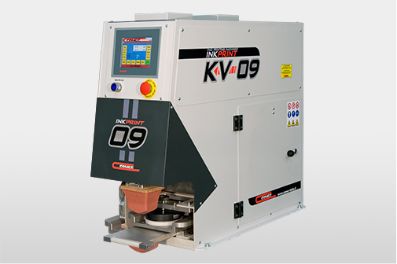
- Operator-loaded production
- Lowest-cost entry point to professional pad printing at various cup sizes
- 90mm, 130mm, 160mm pad sizes
- For job shops, prototype work, low-volume production
- Same ink, plate, and pad technology as automated lines
Pad Printing Machines
Lowest cost-per-part for high-volume, stable-design decoration. EPS has shipped 3,500+ pad printing systems across forty years — more deployed pad-print equipment than any independent integrator in North America.
3,500+ pad systems shippedEPS Pad Printing platforms.
Every standard system below ships with our EAZY START kit including pads, ink cups, and tools. Every EPS pad printer is backed by 40+ years of engineering and application development.
- The 'KP' Series spans more than 8 different models with cup sizes ranging from 60–160mm and a range of options from automatic pad cleaners to safety equipment.
- Choose your options. Choose your automation. Stabilize your production.
- Precise servo control over each axis stroke
- Best repeatability for high-precision work
- KE07, PE09, KV09, KE13, KE16, XE20, XE30, XE Tech 16-20
- Cupslide and oval cup configurations for long, narrow print applications
- Multi-shift production capable
- Programmable cycle parameters per recipe
- Pick-and-place loading
- Pretreatment, decoration, curing, inspection
- Conveyor or rotary indexing
- Vision verification and reject handling
- Bespoke Design of custom Pad Printing Cells
- Robotic pad printing via 6-axis robots
- Designed for catheter, syringe, drink-bottle production
What a pad printing machine actually does.
A pad printing machine transfers ink from an etched plate onto a part using a soft silicone pad. The image is etched into a printing plate — the cliché — which is flooded with ink and then wiped clean, leaving ink sitting only in the etch. The pad presses down onto the plate, lifts the ink, and presses it onto the part.
That indirect step is the whole point. Because the pad is soft, it deforms around the part instead of demanding a flat surface. It will print into a recess, around a curve, across a parting line, onto a textured grip, and onto parts too small or too fragile for most other processes. This is why pad printing still owns applications that look like they should have been displaced years ago — catheters, syringe barrels, switch bezels, sports equipment.
Sealed ink cup or open ink well
The main mechanical distinction between machines is how ink reaches the plate.
Open ink well
Floods the plate from an open tray and wipes it with a doctor blade. Ink sits exposed to air, so solvent evaporates continuously and the operator keeps correcting viscosity through the shift.
Sealed ink cup What EPS builds
The cup rides directly on the plate, holding ink in an enclosed chamber, and its ceramic ring doubles as the doctor blade. Less solvent escapes, viscosity holds far longer, the shop stays cleaner, and color stays consistent across a run.
How to choose between machine types
Four questions settle it, in this order.
- How many colors? Single color is the simplest and cheapest station. Each additional color adds a print station and registration between them. EPS builds one through five.
- Who loads the part? An operator-loaded benchtop machine is the lowest-cost entry point and perfectly reasonable at moderate volume. Above that, the operator — not the printer — sets your real cycle time.
- How repeatable does the stroke need to be? Electro-pneumatic machines are air-driven and electronically controlled: robust, proven, right for most production. Servo-electric gives programmable control over each axis, which matters when registration is tight or the part is delicate.
- What happens either side of the print? Pretreatment, curing, inspection, and handling are usually where the labor actually sits. If those stations are manual, the printer is rarely the constraint.
What the system needs besides the machine
A pad printer is a platform; the consumables decide the result. Every job needs three things matched to each other:
- A plate carrying the etched image
- A silicone pad in a shape and durometer suited to the part geometry
- An ink matched to the substrate — change the plastic and the ink usually changes with it
This is where most adhesion problems are actually decided. Print does not fail because the machine is wrong; it fails because the ink, the substrate, and the pretreatment were never matched to each other. EPS supplies the full consumable set for exactly that reason — the system is the product, not the press.
Industries we deploy Pad Printing into.
Catheter & Medical Devices
EPS dominates the catheter marking market. Pad printing is the only process that decorates the curved, challenging surfaces of catheters with the precision and adhesion medical use demands.
Syringes & Pipettes
Decorating high-volume disposable medical devices with multi-color graduations and lot codes — repeat designs, high throughput, automated.
Cosmetics Packaging
Lipstick tubes, compacts, fragrance caps — multi-color brand decoration on parts that resist most other processes all while transferring the highest quality line fidelity possible that the cosmetic industry has come to demand.
Automotive Interior
Switches, controls, instrument bezels, trim parts. Long product cycles, stable designs, high volumes — the ideal pad-print profile with adhesion capable of holding up to the Automotive specifications Tier 1 suppliers are required to deliver.
Is Pad Printing the right answer for your line?
You decorate high volumes of physically complex parts (curved, recessed, multi-face, fragile) where the same artwork runs for months or years between changes. You need the lowest cost-per-part — and decoration that survives medical, automotive, or industrial use.
Right fit when
- Annual volume per SKU above 100,000 parts
- Design changes annually or quarterly
- Curved, recessed, multi-face, or fragile geometries
- Industrial-grade adhesion and durability requirements
- Medical syringes, catheters, vials, instrument bezels
- Automotive interior trim, switches, controls
- Multi-color requirements on three-dimensional surfaces
Not sure which technology fits your line?
Five questions about your manufacturing environment. We recommend the optimal EPS process and platform — with no sales call required.
Take the Decoration Optimizer →Common questions about pad printing machines
What is a pad printing machine used for?
Decorating three-dimensional parts that other processes struggle with — curved, recessed, textured, multi-face, or fragile. Typical work includes medical devices, automotive interior controls, tools and hardware, sporting goods, cosmetics packaging, and promotional items.
What is the difference between a sealed ink cup and an open ink well?
A sealed ink cup encloses the ink and uses a ceramic ring as the doctor blade, so far less solvent evaporates. Viscosity stays stable longer, color holds across the run, and the work area stays cleaner. An open ink well exposes ink to air and needs constant viscosity correction. All current EPS machines are sealed-cup.
How many colors can a pad printer print?
EPS builds one through five colors. Each color is its own print station with registration between them, so cost and footprint rise with color count. If you need photographic or continuous-tone imagery rather than a handful of spot colors, that is usually a digital inkjet question rather than a pad printing one.
Do I need a benchtop machine or an automated cell?
Start from labour, not from the printer. A benchtop machine loaded by an operator is the lowest-cost way into production and fine at moderate volume. Once an operator is loading every part, that person sets your cycle time and your unit cost — at which point an automated cell that handles loading, pretreatment, curing, and inspection is usually the cheaper machine per part, despite costing more to buy.
What materials can pad printing decorate?
Most engineering plastics, glass, ceramics, coated and bare metals, and many elastomers. The substrate governs the ink and often the pretreatment — low-surface-energy plastics such as polypropylene and polyethylene generally need surface activation before the ink will hold. Durability comes from matching ink, substrate, and pretreatment as a set.
What consumables does a pad printing machine need?
A plate per image, a silicone pad matched to the part shape, ink matched to the substrate, plus solvents and cup rings. Pads and rings are wear items; plates are made per artwork.
Pad printing or digital inkjet — which do I need?
It usually comes down to how often the artwork changes and how many SKUs you run. Pad printing is the lower cost per part when the design is stable and volumes per SKU are high. Digital removes the plate entirely, so it earns its place when you change over frequently, run many short jobs, or need variable data on every part. EPS builds both, which means we have no reason to talk you into the wrong one — the Decoration Optimizer walks through the trade-off, or a cost engineer will do it with your own numbers. The full decision framework is here — the table, the changeover math, and where each process wins.
Talk to an EPS engineer about your part, your volume, and your throughput targets. We'll quote the right system for the work — or tell you a different technology is the better answer.