
 About
About Contact Us
 (800) 272-7764
SinglePass Inkjet Printers
With singlepass industrial inkjet printers, the product passes below a series of print heads only once, producing high throughput speeds for mass production. The image resolution required and the part size determine throughput speed, since the parts pass under the print heads on a continuous conveyor. Some singlepass inkjet systems are able to run at extremely high speeds, up to 50 inches per second and higher. The native resolution of the head is in the cross track direction -for example a print head with 360 nozzles per inch will print in lateral sense at 360 dots per inch (DPI). In the longitudinal direction, singlepass inkjet printers can achieve higher resolutions if the max print head speed is reached and the parts move more slowly under the print heads.In order to increase resolution in the lateral sense, it is possible to add additional print heads in the print direction and offset them by a certain number of pixels to double or triple the DPI in the in track while running at maximum speed. The print width can also be increased by adding print heads in the cross track to increase the print swath by a factor of the print head width.Typical head configurations in our singlepass inkjet printers consist of WW + CYMK. It is also possible to vastly expand the color gamut with the addition of print heads inkjetting Orange, Green, and Violet.Product-marking and –decoration using singlepass inkjet printers is a complex process with many factors to consider, from substrate material to adhesion requirements, from throughput rates to upstream and downstream part-handling. That’s why we are here to help with our full team of software engineers, mechanical engineers, production engineers, and graphic designers. Drop us a line, and let’s start a conversation!
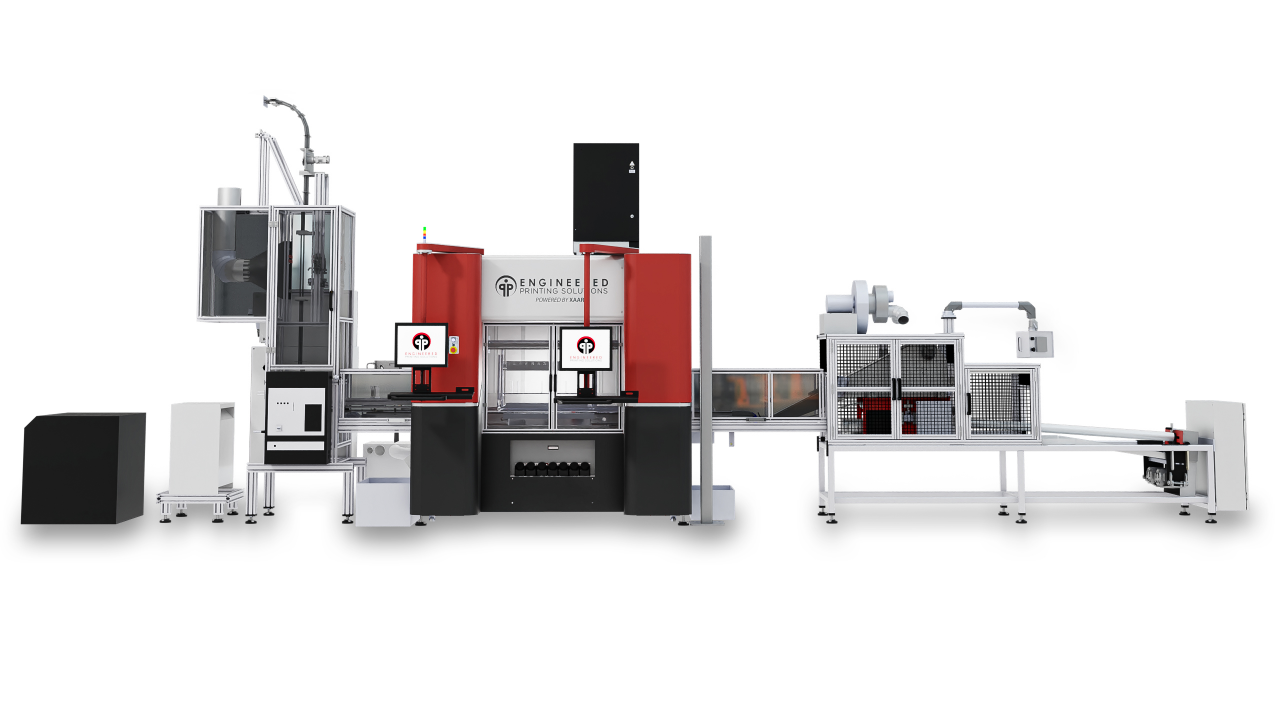
XD Series Singlepass Inkjet Printers

Typical Configuration:
- 70 mm, 108 mm, 140 mm, or 210 mm print widths
- CMYK+WW print heads
- Varnish heads available
- Extended Color Gamut (CMYK+OGV) available
- Four levels of greyscale
- Corona, Flame, or Plasma Pretreatment available
- Drop-on-demand InstaCure UV ink allows printing multiple colors with zero down time
- Custom Part-Loading & Unloading
- Throughput Speed: up to 50"/second
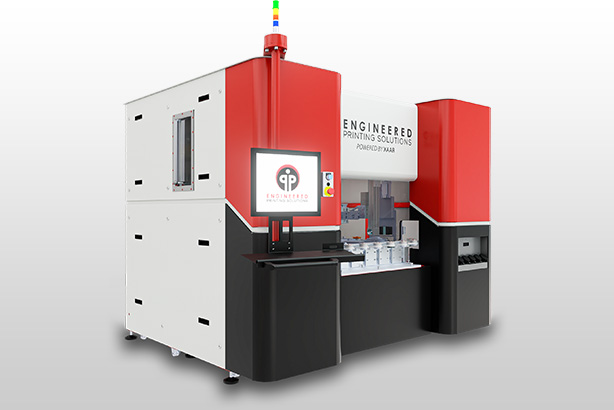
XD-360 Cylindrical Inkjet Printers
Features:
- Inline Pre-Treatment.
- Ink-curing via UV LED.
- Visual Resolution: 720 x 720 dpi (greyscale printheads).
- Native Resolution: 360 x 360 dpi.
- Registration: +/- 10µ color-to-color.
- Five colors (CMYK + W) with varnish option.
- Throughput: up to 1200 pph
XDLT

The XDLT represents a significant leap forward in decorating equipment and the XDLT fills a crucial void in the market, catering to the needs of businesses that require high-quality printing solutions without breaking the bank.
Get ready to embrace the future of printing with the XDLT.
Features:
- Xaar Nitrox Print heads (WWCMYK)
- GIS print electronics for static data
- CIMS II 450 ink management system
- Integration Technologies UV Pin and Cure
- Welded steel frame
- Max printable product size (6in x 8in)(HxW)
- Standard conveyor design (14in/s)
- Manual Z and Cross Track adjustment
- Maintenance Waste Tray
- Ventilation hookup
- Crash Detect included for protection of printhead
- Bechoff Industrial PC with standard HMI interface
- Standard customer interface connector for I/O and E-Stop circuitry
Single Head Test Rig

Our job is to take your idea from concept to full realization.
Engineered Printing Solutions is committed to the continuous improvement of its integration capabilities and the equipment we offer.Over the past 25 years EPS has been forwarding the inkjet revolution with each production system designed and built. However, every advancement must first be qualified and developed to understand the true capabilities.EPS’s Engineering and Application Technicians developed a test rig designed specifically to expedite the qualification, sampling, and validation process for each new venture.EPS is now offering this system to partners looking to integrate inkjet into their automation lines, to create custom samples, to test new ink developments, and / or to test proof of concept application studies for exploring new market opportunities.Features
- Single Xaar Nitrox Printhead
- GIS print electronics for static data (C2 PMB)
- CIMS II ink management system
- Integration Technologies UV Cure
- Extrusion frame
- QC conveyor with Automation Direct Servo
- Bechoff PLC for UV control
- Baumer print encoder to be on stub shaft of QC Conveyor
- Selector switch for pre-canned belt speeds
- Manual Z adjustment
- Optional external laptop for print electronic software and ink management software
- Crash Detect included for protection of printhead
Dedicated Turnkey Single Pass Systems
Over the years, we have perfected single pass inkjet product-marking machines for several specific applications. Click the links below to see some of our dedicated product-marking solutions in action.

Watch The Video
Our hard hat printers have inline corona pretreatment and automated part rotating for printing on all sides.

Watch The Video
Our cold foil single pass inkjet printers are revolutionizing the yearbook, trophy, and awards industries by eliminating the need for hot-stamping machines. By printing decorative metallic finishes inline with instant UV curing, your products are immediately ready for downstream activities such as sorting and packaging.
Watch The Video
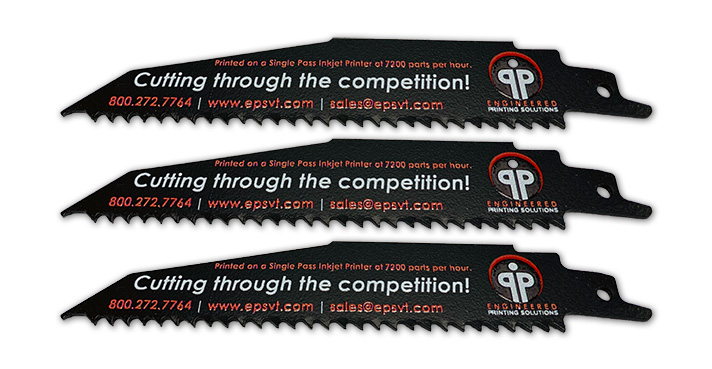
Our single pass saw blade printers cut through the competition.

Watch The Video
High-speed solution for printing on yogurt container lids.
Example applications


