
 About
About Contact Us
 (800) 272-7764
All Fired Up: Pad Printing Glassware
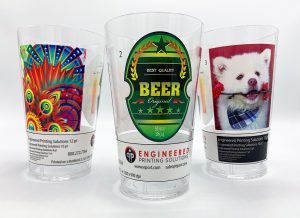
These cups were printed on the BottleJet 2.1 Cylindrical inkjet Printer.
Most glassware has some kind of discernible shape. Logically, pad printing emerges as a natural choice in glass decorating and printing. The more complex the shape, the more suitable pad printing becomes as a decorating process.
With the right tooling, multicolor prints, special-effects inks, and even 360 degree wrap-of-image-around-circumference are possible. Automated parts-handling options can further speed production rates.
There are two primary inks used in pad printing glassware: frit inks and acrylic inks.
Acrylic inks
Acrylic inks are mixed with a catalyst hardener as well as with a solvent thinner, which allows the ‘tack-up’ and transfer from cliché to pad to part. A post-print bake is usually recommended (3-5 minutes at about 200 degrees F) to improve the durability of the print. The bi-component ink mixture typically has a ‘pot life’ of 6-8 hours, after which time the ink hardens on its own, rendering it unusable for any further printing.
Acrylic inks are fairly durable, providing at least 50 wash cycles in your average home dishwasher.
Frit inks
For greater durability, a frit ink is the way to go.
Frit inks contain:
- Finely ground glass particles in the ink mixture (very small, only a few microns in size)
- A pigment (the colorant)
- A binder, which is a carrier used to keep the ingredients in suspension
- A thinner, the solvent which facilitates the silicone pad transfer process.
Different frit suppliers recommend different combinations of the above four components. There are no pot life issues to consider when using frit inks.
After printing with the frit ink, the printed ware is fired in a kiln, typically at about 1100 degrees F on average for up to 30 minutes. The ground-glass particles come very close to their melt point; the organic ingredients in the print burn off, and a physical bond is created between the print and the product. Frit inks are generally considered the most durable of all glassware prints, capable of lasting a lifetime and providing tremendous abrasion resistance.
Have you had glassware decorating challenges? Feel free to contact us for advice on the best options for all types of pad printing on glassware.