
 About
About Contact Us
 (800) 272-7764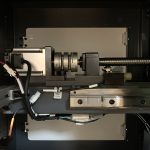
New servo motor replaces step motor for increased repeatability and reliability.
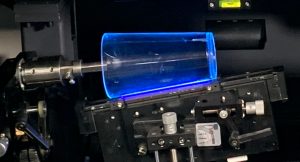 Engineered Printing Solutions is pleased to announce a new version of its celebrated BottleJet Cylindrical Inkjet Printer—the BottleJet 2.1. Highlights include an improved lead screw motion motor, which is now servo-electric instead of a “step” motor for increased repeatability and reliability. Other improvements include an improved bottle fixture, with additional guide rollers that can be installed and removed easily thanks to a quick-release latch. We’ve also added a second mandrel with a shorter stem to accommodate larger bottles.
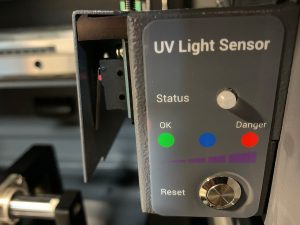
The UV sensor will prevent accidental curing of print heads.
Perhaps the single-biggest change over the previous model is the addition of a UV light sensor to prevent accidental damage to the print heads. If the sensor detects the presence of UV light, the machine cancels the print job and returns to its home position. In addition, there is a new lamp curtain window, which allows the operator to close off unused sections of the lamp that are not required for the curing process. In previous designs you had to remove the second lamp when not in use and tape over any sections that were not being used in the remaining lamp. A new angle-adjustment knob allows speedy adjustments of the curing lamp, where previously it was necessary to loosen a bolt to make adjustments. This time-saving feature will be much-appreciated by operators. Finally, the curing lamp can now be adjusted to have a negative angle, which means that the BottleJet can now print cylindrical objects with the print heads moving from the top of the part to the bottom without the need for reverse-tooling.
The BottleJet 2.1 has other upgrades as well. A new red laser guide on the head carriage enables the operator to easily set the print origin on the part. An improved method for stirring white inks even when the machine is off reduces startup time. Even the firmware has been upgraded to power the new features of the BottleJet 2.1.
Want to find out more about the new BottleJet 2.1 cylindrical inkjet printer? Drop us a line!

The BottleJet 2.1 can produce photo-quality images in under a minute.
In pad printing, seconds matter.
Pad printers are an excellent solution to product-marking and -decoration when runs are long, the artwork is fairly simple, and part topography precludes an inkjet solution. But as with any form of “contact” printing, there are theoretical limits to throughput speed. The pad can only move so fast, or the ink needs a minimum time period to cure before downstream activities can take place.
Doubling the number of pads, plates, fixtures, and parts doubles throughput, but duplication also adds considerably to the cost of the machine. Prospective customers also frequently bring up the topic of a rotary table to move parts past the pads and ink cups, but this only speeds up throughput if there are preliminary steps such as pretreatment for adhesion required for the printing process, as regardless of how many stations there are on a rotary table, the operator still only has two hands with which to load the machine. Another problem with trying to increase throughput through the use of a rotary table is the actual movement of the table itself; the operator can only load parts onto the table when it is stationary.
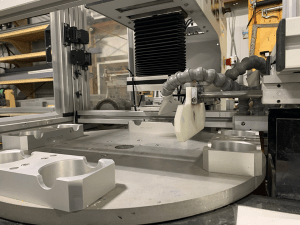
Fig. 1: A simple rake with pneumatic control for off-loading parts can increase throughput by eliminating one human touch.
Sometimes simple additions to standard operations can add significant throughput gains with very little added cost. When trying to increase throughput, a good place to start is in minimizing the number of “touches” a machine operator must make on a part. Either loading or off-loading can be automated. One solution for off-loading parts is a simple rake, driven by pressurized air, to pull parts off of the fixture. (See figure 1.) This frees the operator to focus solely on loading parts into the machine.
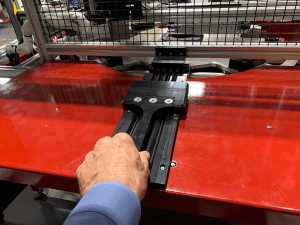
Fig. 2: EPS designed this loading mechanism to enable the operator to load parts even while the table is rotating.
EPS has designed a loading mechanism that “pre-loads” parts into position, and then vacuum sucks the parts onto the fixture once the table has come into position and is at a standstill. This automated load can occur much faster than if a human operator had to do it. (see figure 2.)
These are just a few examples of innovative, one-off solutions we have found for our customers. Sometimes, seconds can be gained just by having one of our Sales Engineers visit your facility and discuss your operation. Our experience in manufacturing processes in a wide variety of industry verticals—Automotive, Medical Device, Health & Safety—has taught us many operational strategies that may offer ways to shave precious seconds off your production process. Customers trust us to find a solution to their part-marking problem because they know that we understand that seconds matter; if you can go from a four-second print cycle to a three-second print cycle, over the course of a shift, a day, or a year, those seconds add up to real cost-savings for our customers.
Automated Parts-Handling Can Shave Seconds Off of a Production Process
- Some work environments can benefit by trimming seconds out of their processes.
- Sometimes simple additions to standard operations can add significant throughput gains with very little added cost.
- Sometimes seconds can be gained just by having a Sales Engineer come in to discuss your operation. Our experience in manufacturing facilities across industry verticals exposes us to many operational strategies that may offer ways to save you time and money.
Want to find out more about custom automation solutions for your part-marking job? Drop us a line!
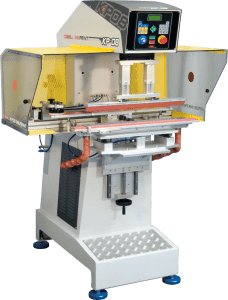
Catheter Marking Machine
The global coronavirus pandemic has forced the cancellation of all in-person trade shows for the remainder of 2020. It has also brought business travel to a standstill, resulting in far fewer opportunities to connect with customers and prospects. Throughout it all, Engineered Printing Solutions has remained open and has been actively supporting and serving the medical device manufacturing industry. With the cancellation of BIOMEDDevice Boston, EPS will be hosting a Virtual Trade Show on September 17th and 18th. We would love the opportunity to “see” you and share your current projects with us.
Is now the right time to go digital?
Our Virtual Trade Show is free to attend. The September 17th session will be devoted to pad printing and will include machine demonstrations as well as live Q & A. September 18th will be devoted to industrial inkjet, also featuring live machine demonstrations and Q & A. Bring your questions about adhesion, fixturing, whatever you want. Space is limited, so please reserve your spot today!
Reserve Your Spot Today!
Day 1 will begin with remarks from the EPS leadership team, providing a brief company history and outlining our capabilities. Next, we will cover ink-mixing and cliché preparation for pad print applications. We will then cover setting up a pad print machine for printing, and will demonstrate a catheter pad printer. The remainder of the morning session will be open to Q & A.
Day 2 will focus on industrial inkjet printing. We will start with a general discussion about converting from analog to digital product-marking solutions, and some of the factors to consider in making that investment. We will then demonstrate the BottleJet 2.0, an industrial inkjet printer designed to print drinkware and other cylindrical objects. We will also demonstrate flatbed inkjet printers and finally, singlepass inkjet printers. As on the previous day, the remainder of the morning session will be open to group discussion and Q & A.
On both days, our sales engineers will be available in the afternoon for one-on-one breakout sessions. Bring your product-marking challenge to us, and let’s get down into the weeds of your project! Don’t miss this free opportunity to plumb our twenty-five years’ worth of experience in building product-marking machines for every application.
Register Today!

Studies indicate that 90 percent of snap judgments made about products are based on color alone.
One of the most exciting recent developments at Engineered Printing Solutions has been the expansion of process colors to singlepass machines. Often called extended gamut machines, the addition of orange, green, and violet allows for the printing of many more colors than CMYK alone, without the use of spot colors.
Why Extended Gamut?
The demand for extended color gamuts largely parallels the adoption of digital part-decoration over traditional analog methods. Historically, printers using analog methods such as offset, screen, or pad printing have added spot colors to achieve precisely the results their customers demanded. By contrast, industrial inkjet printers have historically built up color using just cyan, magenta, yellow, and black. This simplifies printer design, but by using just these four colors, many colors in the visible spectrum are unachievable.
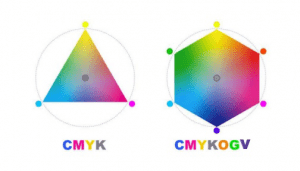
The addition of orange, green, and violet greatly extends the color gamut over CMYK alone.
Expanding from CMYK to CMYKOVG is the most common method of extending the gamut. Typically, in CMYK process there have been gaps or smaller defined areas of the deep green, bright orange or violet shades. Adding these colors to the process results in a broader range of colors available to print via inkjet. Dense reds such as the one used in the Coca-Cola™ logo have also presented challenges with traditional CMYK process. The addition of orange, green, and violet make that color more achievable without having to increase resolution or ink builds.
The addition of orange, green, and violet significantly expands the possible gamut, allowing more vivid designs and greater possibilities for economic short runs. The more colors achievable, the more products you can run, and the better you can serve your customers.
As the conversion from analog to digital becomes more widespread, customers are beginning to require higher quality images to convert. Some are requiring colors that are typically difficult with just CMYK. Others are simply looking to duplicate the colors already in place using current offset/analog systems.
What Are the Drawbacks of an Extended Color Gamut?
The print engine itself is the most costly part of most print systems, so additional print heads along with their concomitant costs such as necessary ink management systems will add to the price of a print system. OEM and contract part decorators will have to make their own ROI calculation based on the size of runs, the number of SKUs to run, and the desired image quality. Fortunately, our Sales Engineers have helped many customers with just this sort of calculus, and are eager to help you design your next printing solution.
Want to learn more about extended color gamuts? Drop us a line!
At Engineered Printing Solutions, we design direct-to-object product-marking machines with custom automation and part-handling. As it says on the bottom of every page on this site, “No two print machines are alike.”
This is no mere slogan. So many factors go into the design of a particular printing machine, from part topography and substrate to image size and quality to desired throughput speed.
And this does not even broach the performance requirements of the part. Perhaps it is an engine part that will be exposed to heat, dirt, and solvents. Perhaps the part is drinkware and the image must withstand multiple trips through the dishwasher. Every project has its unique challenges, and for this reason, no two print machines are alike.
This fact has several implications, one of them being that we do not have an inventory of standard machines sitting on the shelf that we sell directly into various industries. Another consequence of designing and building bespoke part-decorating equipment is that over the years we have learned the right questions to ask potential customers in order to create the printing machine that fits their needs perfectly. As a result, our Sales Engineers have gained expertise in Operations Management.
It all starts with a few basic questions. What is the part topography? What is the substrate? hat is the size and desired quality of the image to be printed? And perhaps most importantly, what is the desired throughput in parts per hour? Answers to these questions will help our Sales Engineers to find the right solution for you.
I was reminded of the depth of knowledge among our sales staff—many of whom started with the company as technicians, so they have hands-on knowledge of the machinery they sell—at our weekly sales meeting recently. As is often the case, the Sales Engineers were discussing a particular project that one among them was wrestling with for a potential customer. The Sales Engineer was proposing a digital solution but was struggling both with the curvature of the part and also the desired throughput. Initially, he proposed increasing throughput by adding a second print array, but was discouraged from doing so by his colleagues, as multiple print arrays quickly become prohibitively expensive.
One person pointed out that the limited-palette artwork and part topography suggested that an automated pad printing solution might be more appropriate and cost-effective for the customer. At this point, someone proposed twin independent pads in order to double the throughput. A rotary table was also proposed as a solution to increase throughput, but it was quickly concluded that neither of these solutions addressed the real constraint to higher throughput: the fact that the operator still only has two hands with which to load parts. (If you think about it, a rotary table primarily serves the purpose of permitting parts to move past inline pretreatment, but it does nothing to increase throughput, as the same person must load parts, whether onto a rotary table or directly to the print station.)
The important take-away from this is that every project at EPS starts with basic questions regarding throughput, part topography, and image size and quality. All hardware considerations flow from this information. Truly, no two print machines are alike.
Want to find out more about bespoke product-marking solutions for your project? Drop us a line!
As the novel coronavirus has swept the globe, Engineered Printing Solutions has chronicled the response of the manufacturing sector to the sudden halt of production for many products as well as the rapid shift to production of products used in the fight against the pandemic. We have also reported about our own response to the challenges of keeping our employees safe and healthy even as we and our customers are deemed essential in the struggle to control the spread of the disease.
As we have reported, we have stayed open and healthy through strict adherence to CDC and Vermont state guidelines, which has meant that we have met and responded to heightened interest in catheter-marking machines.
KP08 Catheter Printer
EPS has a long history of serving the catheter industry. Almost since our inception as Pad Print Machinery of Vermont, we have been building machines to mark catheters. Over that time, we have designed and built pad print machines for marking catheters with a range of part-handling capabilities. We tell our customers that no two machines are alike, and a look at the array of upstream and downstream solutions we have devised shows just how true that is. From vacuum-fed part-loaders to downstream cutters and bobbins, we have built catheter-marking machines that can either spool the finished part or cut it to length. From single-color catheter pad printers to pad print machines that print as many as 14 colors, as well as several inline pretreatment options, our catheter-marking machinery is designed to integrate with your production line at the throughput speeds you require. And with an Ink Department that can mix custom Class VI Medical Grade Inks, you are sure to get just the colors you need.
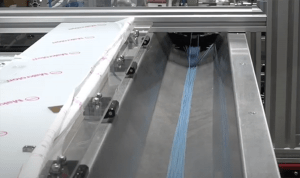
Vacuum-fed catheter part feeder
Want to find out more about how we have served the medical device industry for years, particularly the catheter industry? Take a look at our Medical Device Part-Marking Machines page. There you will see a variety of videos catheter-marking machines we have built over the years. If you watch a few of the videos, you will notice that, while each machine may resemble the others when it comes to the actual pad printing on the part, the upstream and downstream capabilities of each machine are unique to the customer. Truly, “No two print machines are alike.”
If you’ve got a project involving catheter-marking, drop us a line. Let us design a solution for you!

The metallic effect on this cosmetics packaging was created with cold foil printing.
Hot foil stamping has been around for centuries. With this method, a die uses both heat and pressure to adhere the foil and a heat-activated adhesive to the substrate.
Cold foil printing is a relatively new technology. Inkjet print heads jet UV-activated adhesive onto a substrate, and foil is briefly pressed onto the substrate and passed under a UV light. The adhesive cures instantly, and the foil is stripped away, remaining only where there was adhesive.
At EPS we are excited about the decorative possibilities of cold foil printing. To us, the usual advantages of digital inkjet (the potential for variable data, or print-runs of just one unit) only add to the advantages of cold foil printing versus hot stamping. In addition, heat and pressure are not viable options for some substrates. Furthermore, drop-on-demand technology means gradients are possible.
Advantages of Cold Foil Printing vs. Hot Stamping:
- Heat, pressure not viable options for some substrates
- Drop-on-Demand means gradients are possible
- Lower tooling costs
- Less make-ready and downtime
- Inline process vs. secondary process
- Colors, varnishes, coatings can be applied inline over foil
- Reduced need to store semi-finished goods;
- Faster speed-to-market
But the biggest single advantage of cold foil printing over hot stamping is the lack of tooling costs. With hot stamping, whether you are making one part or a million, you first need to make a stamping die. With cold foil printing, there is no need for a die, and thanks to variable data capabilities, a part decorator could have a production run of a million parts, each one marked differently.
Because there is no die to change, make-ready and downtime is much less with cold foil. According to some estimates, hot stamp average changeover time can take anywhere from a half-hour to 8 hours, whereas changeovers on a digital inkjet print machine can be as simple as a few clicks of a mouse.
Other advantages of cold foil printing revolve around the fact that cold foil is an inline process as opposed to a secondary, offline process, meaning final part decoration can occur immediately after the part pops out of an injection mold. Not only does this eliminate the need to store and handle semi-finished goods, but colors, varnishes, and other coatings can be applied inline over the foil in a seamless, integrated process. All of these factors lower cost and increase speed-to-market.
You can read about how one company converted to cold-foil printing here.

Want to find out more about cold foil printing? Drop us a line!
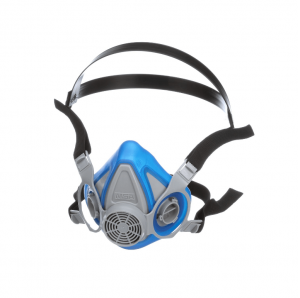
The Advantage 200 face mask. Image courtesy of MSA.
In our continuing coverage of the manufacturing sector’s response to the COVID-19 pandemic, we have talked about what we are doing to ensure the safety of our employees and their families. We have also told of unusual collaborations between manufacturers as well as incredible tales of lightning-fast speed-to-market.
For our part, we have seen strong demand for direct-to-object part-marking machines, particularly in the safety equipment, food packaging, or medical device manufacturing sectors. So we reached out to our customers to see how they were adapting to manufacturing in light of the pandemic, and to see whether any of them had any interesting stories of their own of manufacturing products essential in the fight against the disease. For one company, MSA, located outside of Pittsburgh, Pennsylvania, the COVID-19 pandemic has meant a surge in demand for its products.
MSA, whose slogan is “The Safety Company”, is a leading manufacturer of HEFH (Head/Eye/Face/Hearing) safety equipment. Recently, MSA donated 65,000 N95 masks to the Allegheny Health Network in Pennsylvania for healthcare providers battling COVID-19. MSA is also rapidly expanding production of its Advantage® 200 respirator. Rene Burger, Global Manufacturing Engineering Manager for MSA, reports that the entire MSA Family has been working around the clock seven days a week since the pandemic started to ramp-up production.
MSA is also a customer of Engineered Printing Solutions. EPS built a singlepass inkjet machine for the company, complete with inline corona pretreatment. MSA chose a digital solution because they wanted the possibility of economical short runs, including the ability to mark parts with variable data such as an employee’s name or even blood type.
Are you in the safety equipment, food packaging, or medical device manufacturing business? How has the coronavirus pandemic affected your business? Have you converted production to essential items? Tell us your story! And as always, if we can help contribute to your success, we are here for you. EPS is open and filling orders for print consumables as well as machine orders.
Drop us a line!
“The very first priority for manufacturers is to make sure that our workers, their families and their communities are safe and healthy,” he said. “Once we can ensure that that occurs, obviously we’re going to continue to ramp up production.”
—Jay Timmons, president and CEO of the National Association of Manufacturers (NAM)
By now, we have all seen our inboxes flooded with emails from every company we’ve ever done business with telling us how they are dealing with the coronavirus. We’ve been guilty of it ourselves. But beyond handwashing and physical distancing, how are companies manufacturing products in the “new normal”?
The COVID-19 pandemic has sent a huge shock through the manufacturing sector from a supply chain standpoint as well as on the demand side. Whole industries have shut down.
But the need for some manufactured products has increased, particularly medical products necessary in the fight against the pandemic, and many manufacturers are retooling their lines to produce the products in demand. For example, Ford has announced that it will be manufacturing 50,000 ventilators within 100 days. General Motors has also teamed up with a Seattle-based medical device manufacturer to rapidly scale up production of ventilators. According to the two companies, GM will provide logistics, purchasing, and manufacturing expertise, and will manufacture ventilators at its Kokomo, Indiana, facility. GM will also manufacture surgical masks in its Warren, Michigan, facility.

Ventilator used in the fight against COVID-19. Image courtesy of Ventec Life Systems
The federal government awarded GM the contract to manufacture 30,000 ventilators by August at its Kokomo facility on April 8. On April 14th, GM announced that 600 ventilators were ready to ship, that half the order would be ready by the end of June, and that the full order would be ready as promised.
Automakers are not alone. AB InBev, maker of two out of every three beers in the world, is making hand sanitizer from surplus alcohol in its breweries around the world. Bauer Hockey, the Canadian hockey equipment manufacturer, is making face shields. The luxury goods conglomerate LVMH has converted production from its perfume plants to sanitizer production. Even Giorgio Armani converted all of its textile factories in Italy to the manufacture of single-use medical overalls. Prada is making face masks.
Perhaps the most astonishing thing about manufacturers’ responses to the COVID-19 crisis is the speed with which companies have adapted and retooled. The GM initiative came into being in only 48 hours, led by GM employees themselves.
But just exactly how do companies boost manufacturing production by a factor of two, or even five, or ten? The answer is not obvious, and demonstrates both the fragility and the robustness of our manufacturing sector.
Few companies operate at 50 percent capacity. Indeed, few could survive very long at such capacity rates. So how have companies ramped up output so quickly in response to the coronavirus pandemic?
An obvious first place to start is by reducing the number of SKUs and converting production lines to the manufacture of SKUs deemed essential. But beyond about 2X, other factors start to intrude. The physical plant (number of assembly lines or the square footage of the factory floor) quickly becomes a constraint. So too do upstream suppliers, who also maintain lean inventories.
The experience of the Seattle-based ventilator manufacturer is instructive. When faced with the task of rapidly scaling production output, Ventec found that their suppliers were not responding to their requests for increased upstream supply. Within half an hour of Ventec meeting with representatives from GM, GM’s suppliers in India visited Ventec’s Indian suppliers, and the bottleneck was resolved.
A similar story played out with GM’s domestic suppliers. Twin City Die Castings Company manufactures pistons for GM cars. With car part production sidelined, the company was casting about for ways to keep its workers employed. The company realized that while they may not know much about the manufacture of ventilators, they knew a lot about the manufacture of pistons and cylinders to extremely tight tolerances. As a result of intermediation on the part of General Motors, Twin Cities is supplying Ventec with pistons for ventilators, enabling Ventec to ramp up output by a factor of ten.
Here at Engineered Printing Solutions, we have long been a supplier of direct-to-object product-marking machines for the medical device industry, so it was only natural that when many of our existing customers began ramping up production that they would come to us. One such company did so just last week. So too have food processing and packaging companies.
EPS is proud to be part of the effort to beat this pandemic while still keeping its employees safe and employed. We are here for you, so drop us a line, and let’s start a conversation!
KP08 Catheter Printer
As we’ve noted before, many of our customers have been deemed “essential” in the fight against COVID-19. Last week, one reached out to us to say that they had been contacted by the White House COVID-19 Task Force about dramatically ramping up production of medical devices in anticipation of enormous demand. They wanted to know, could we deliver a catheter printing machine in two to three weeks?
EPS has built medical product printing machines for many customers, so the technical challenges were slight. The greater challenges were logistical in the “new normal” of physical distancing. How would we conduct the Factory Acceptance Test (FAT)? How would we perform the standard installation, which usually involves sending a technician to the customer’s facility for onsite installation and training?
The coronavirus pandemic has disrupted every aspect of the global economy, but perhaps nowhere more so than in the manufacturing sector, where working from home just isn’t a possibility. We’ve written in the past about our efforts to “flatten the curve” and keep our employees safe and healthy, and we are continuing to follow CDC and state guidelines as they evolve. Our sales department is working from home but continuing to communicate with customers. Our software engineers are also working remotely. Additionally, EPS is investigating opportunities under the CARES Act, passed by Congress to encourage companies to retain workers during the COVID-19 crisis, in order to ensure that we can continue to offer our full range of goods and services, from industrial inkjet printers and pad print machines to custom pad print pads and laser-engraved pad print clichés. We have not reduced our workforce. Our capabilities remain undiminished, and we will do everything we can to keep our team intact.
Our assembly department is also adopting best practices to discourage the spread of the virus. Our production floor is large, as are our machines, so physical distancing has always been the case for us. Similarly, nitrile gloves have always been standard equipment, since ink can be messy. Isopropyl alcohol is a standard item found on every work bench. Masks are available for any who wish to wear one. In addition, we have adopted flex-time schedules, with some of our employees coming in to work in the evenings and on weekends.
Our curve-flattening measures seem to be paying off. To date, not a single employee of EPS has tested positive for the coronavirus, and we have been able to provide an uninterrupted supply of print consumables. We are also taking new machine orders and fulfilling existing orders.
In short, we are able to provide the full range of products and services that we always provide. We will deliver the medical device-marking machine to our customer in the time-frame allotted, along with providing clichés with their artwork. We have begun conducting FATs by video, and we have had the ability to remotely diagnose and service machines for years, so we continue to provide the after-sales service we pride ourselves on.
Life may never go back to as before, but some things won’t change. Engineered Printing Solutions will still offer a complete range of industrial inkjet printers, pad print machines, ancillary equipment such as pretreatment systems, part-loading and –unloading automation, dryers, laser cliché makers, and other optional devices, as well as custom pad print pads, inks, and printing plates for your direct-to-object part-decoration needs.
Got a part-decorating challenge? Drop us a line—let’s start a conversation!