
Manufacturers do not usually begin an automation project because they want more equipment. They begin because an existing process has become difficult to staff, inconsistent to operate or increasingly expensive to operate and scale.
In addition, across US manufacturing, recruiting and retaining production employees with the right skills is adding pressure to processes that have traditionally depended on manual intervention. When experienced operators leave, manufacturers not only lose headcount they also lose process knowledge, consistency and productive time while replacement employees are recruited and trained.
Taking product decoration as an example, in many factories, printing remains one of the last production stages to depend heavily on manual handling. Operators load and unload parts, position products in fixtures, make adjustments between jobs, inspect finished items and manage frequent artwork changes. Each activity may appear manageable in isolation, but together they can have a significant impact on throughput, consistency and true cost per part.
This is why interest in automated direct-to-object printing is growing. Manufacturers are looking beyond the print engine and labor recruitment and skills issues and are considering how decoration can become a more integrated, repeatable part of their wider production process.
Why labor availability is accelerating automation
Today, the challenge for manufacturers is not simply the hourly cost of an operator. It is whether manufacturers can find, train and retain enough people to run labor-intensive processes reliably across every shift. Recruitment difficulties can restrict production even when customer demand and equipment capacity are available. New employees require training, while staff turnover can repeatedly remove knowledge from the process. Where print quality, product positioning or machinery setup depends heavily on individual experience, the loss of a skilled operator may also lead to longer changeovers, increased variation and greater supervision requirements.
These pressures are contributing to greater investment in manufacturing automation. In the 2025 annual survey from Plastics Machinery & Manufacturing, nearly half of respondents said labor shortages had negatively affected their businesses. Fifty-seven per cent said they planned to purchase robots or other automation equipment in 2026.
The scale of the workforce involved is substantial with the US Bureau of Labor Statistics data showing that plastics and rubber products manufacturing employed 695,800 people in April 2026, including 526,000 production and non-supervisory employees. Average hourly earnings were $32.03 for all employees and $26.07 for production and non-supervisory employees.
These figures do not mean that automation is simply about replacing employees. Rather, they demonstrate why manufacturers need to use available labor more effectively. Automating repetitive handling, positioning, pretreatment and inspection can allow employees to concentrate on supervision, quality, maintenance and other activities where their judgement and experience create greater value. The result can be a more resilient production process that is less vulnerable to vacancies, turnover and variations in operator experience.
The hidden labor in product decoration
The visible labor cost in a printing process is the time an operator spends running the machine. The less visible costs can be more significant and include everything from training new employees, covering staff turnover, managing variation between shifts, completing manual setup, correcting positioning errors, carrying out visual inspection and stopping production for changeovers – an exhaustive list! A process may use relatively little ink or have an apparently low consumables cost yet still be super expensive because of the human activity surrounding it.
Manufacturers are therefore increasingly seeking decoration systems that reduce manual labor, improve consistency between shifts and support scalable workflows. There is now a move toward production cells that combine printing with robotics, pretreatment, vision inspection and material handling. By looking at the complete process, rather than the printing step alone, manufacturers can get a more accurate basis for an automation decision.
Automation does not have to mean lights-out production
One misconception is that manufacturers must choose between a manual system and a completely autonomous production line. In practice, automation is usually a progression.
Operator-assisted production can automate printing and curing while retaining manual product loading and unloading. This can improve print repeatability without demanding a major change to the surrounding process.
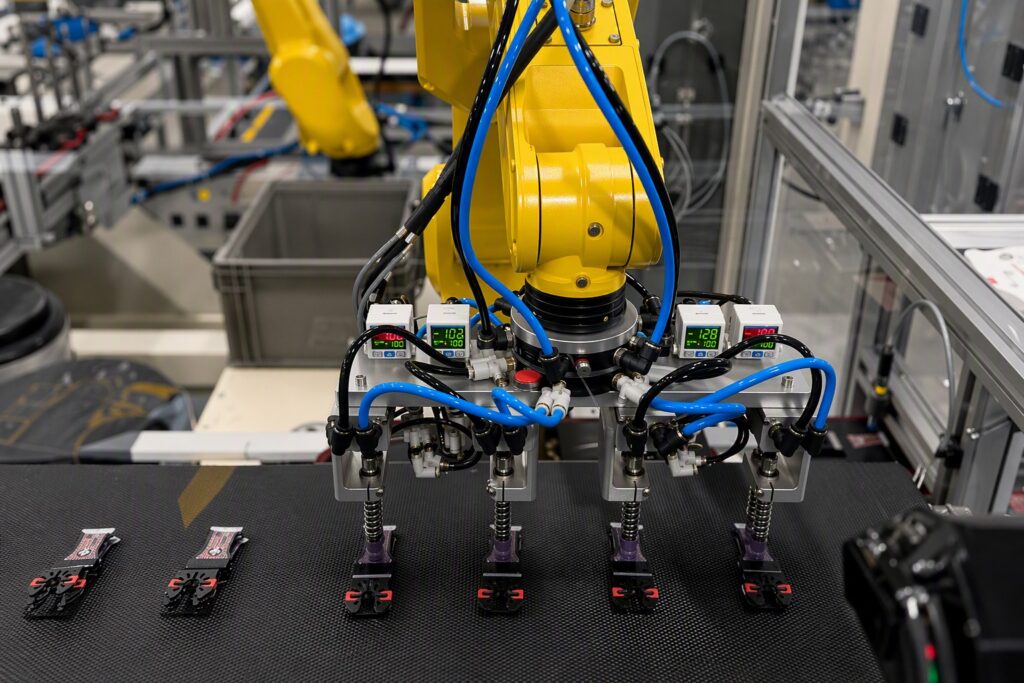
Semi-automated production may introduce conveyors, indexed fixtures, automated pretreatment or robotic handling. The operator supervises the cell and replenishes parts but performs fewer repetitive tasks. Integrated production connects printing with automated loading, surface treatment, curing, inspection and unloading. Recipes and digital job data support predictable changeovers, while vision systems help verify positioning and output.
Lights-out or near-lights-out decoration minimizes routine human intervention as parts move through the system automatically, with software, sensors and inspection technology helping to maintain process control. The right destination always depends on the application. For example, A business with frequent short runs and highly varied products may require a different level of automation from a manufacturer producing the same component continuously across several shifts.
Start with the production problem, not the printer
Before selecting a technology, manufacturers should define the constraint they are trying to remove. Is manual loading limiting throughput? Are experienced operators difficult to recruit or retain? Do results vary between shifts? Is inspection creating a bottleneck? Are artwork changes and mechanical setup consuming too much production time? Is the business struggling to add capacity without adding equivalent headcount?
These questions are important because the most valuable automation may sit before or after the printer. A faster print engine will not solve a bottleneck caused by slow loading, inconsistent pretreatment or manual inspection. Therefore a successful automated DTO project should consider the complete production cell, including:
- part presentation and orientation
- fixtures and material handling
- surface pretreatment
- print technology and ink chemistry
- curing
- vision inspection
- rejection or rework processes
- job data and recipe management
- traceability
- loading and unloading
The goal is to establish a stable workflow that produces consistent results with less dependence on repetitive manual activity.
Measure the true cost per decorated part
An automation investment should be evaluated against the full cost of the current process.
That calculation should include operator time, setup, training, scrap, rework, tooling, changeovers, inspection and downtime as well as ink and other consumables. It should also reflect the production mix. A plant running many short jobs with frequent artwork changes will have a different cost profile from one producing a single design at high volume.
Digital DTO can remove plates, screens and clichés from suitable applications, allowing artwork to be changed through the digital workflow. When combined with automated handling and inspection, it can also reduce the amount of operator intervention needed to maintain production.
However, automation should not be presented as a universal replacement for people or for every established decorating process. The investment case needs to be built around the particular product, substrate, volume, quality requirements and workflow. In some applications, a hybrid approach using different print technologies for different run lengths may provide the strongest economic result.
Consistency can be as valuable as labor reduction
Reducing operator hours is easy to understand, but consistency may deliver equal or greater value. Automated handling can help position products in the same way each time. Controlled pretreatment can support more predictable adhesion. Stored job recipes can reduce the variation created by manual adjustment. Vision inspection can identify defects or positioning problems within the production process rather than relying solely on end-of-line checks.
These capabilities can help manufacturers achieve more consistent output across shifts and sites. They can also make changeovers more predictable and support traceability where individual products require unique codes or production data. This matters particularly in applications where the decoration carries regulatory, instructional or identification information as well as branding.
Build an automation roadmap
For many manufacturers, the most practical first step is not a complete lights-out line. It is an assessment of where manual effort, variation and downtime occur today. That assessment can identify quick wins, such as automating pretreatment, part movement or inspection, while also defining a longer-term route toward greater integration. Equipment and controls can then be specified with future expansion in mind.
The roadmap should answer four questions:
- Which manual activities currently contribute most to cost or variation?
- Where is the real production bottleneck?
- What level of flexibility will future products and artwork require?
- How can the cell be expanded without replacing the core printing platform?
By answering these questions early, manufacturers can make automation decisions around operational value rather than individual machine specifications.
A better way to produce
Automated direct-to-object printing is not simply about replacing a manual printing process with a digital one. It is about reconsidering how decoration fits into manufacturing and how available people can be used most effectively.
When printing, handling, pretreatment, curing, inspection and production data are designed as one workflow, decoration can become more scalable, consistent and predictable. Repetitive intervention can be reduced, while employees focus on supervision, quality, maintenance and process improvement.
For manufacturers facing labor recruitment difficulties, skills shortages or rising production requirements and costs, this can create a more resilient route to growth. The result is not only a better way to print – it can be a better way to produce.
EPS designs direct-to-object printing systems and integrated production cells around each customer’s application, production volumes, substrates and automation goals. Learn more about EPS direct-to-object printing solutions or contact the team to discuss where automation could add the greatest value to your decoration process. LINK
FAQs
What is automated direct-to-object printing?
Automated direct-to-object printing combines digital or conventional printing technology with equipment that handles other parts of the decoration process. Depending on the application, this can include automated product loading, surface pretreatment, print positioning, curing, vision inspection and unloading.
The objective is to create a more integrated production workflow with less dependence on repetitive manual tasks. This can help manufacturers improve consistency between shifts, reduce handling requirements and scale production without increasing labor at the same rate.
Which parts of a product-decoration process can be automated?
Automation can potentially be applied before, during and after the printing stage. The appropriate combination will depend on the product, material, production volume and quality requirements. The key is to identify the actual production constraint. A faster printer will not necessarily increase output if manual loading, pretreatment or inspection remains the main bottleneck. EPS therefore approaches automation as a complete production-cell challenge rather than treating the printer as an isolated piece of equipment.
Can an existing printing process be partially automated?
Yes. Manufacturers do not necessarily need to move directly from a manual process to a fully automated production line. An operator-assisted system might retain manual loading and unloading while automating printing and curing. A semi-automated cell could add conveyors, indexed fixtures, pretreatment equipment, robotic handling or inspection. Further automation can then be introduced as production requirements develop.
Does DTO printing automation only make sense for high-volume production?
Not necessarily, production volume is important, but it is not the only factor that determines the value of automation. Automation may also be valuable when a manufacturer has difficulty recruiting or retaining operators, experiences variation between shifts, handles products that are repetitive or ergonomically difficult to load, or needs better process control and traceability.
Digital direct-to-object printing can also support shorter runs and frequent artwork changes because digital job files can reduce the need for traditional plates, screens or clichés in suitable applications. However, the financial case should always be based on the specific product mix, production requirements and total cost per decorated part.
What information is needed to calculate automation ROI with DTO printing?
A useful return-on-investment calculation should consider the entire decoration process, rather than comparing machinery costs or ink consumption alone. Manufacturers should also consider the value of more consistent output, additional capacity and reduced dependence on difficult-to-recruit skills. EPS has found that operator time, training, turnover, manual setup and shift-to-shift variation can outweigh consumable costs in many decoration environments.
The most meaningful calculation is therefore the true cost per acceptable decorated part, not simply the cost of ink per item.
What is the difference between semi-automated and lights-out printing?
In a semi-automated printing process, equipment completes some repetitive production tasks, but an operator remains involved. The operator might load products, replenish components, supervise the cell, select jobs or remove finished parts. In a lights-out or near-lights-out process, products move through printing, curing, inspection and tracking with minimal routine intervention. Automated handling, sensors, stored production recipes, inspection systems and process controls work together to maintain the workflow.
At EPS we are seeing a progression from operator-assisted automation towards semi-autonomous operation and, where the application supports it, lights-out decoration.
Where should you start with printing automation?
Every decoration process has different products, production volumes and operational constraints. EPS designs direct-to-object printing systems and integrated production cells around the complete application, from product handling and pretreatment to printing, curing and inspection.
Explore EPS direct-to-object printing solutions or contact the EPS team to discuss where automation could create the greatest improvement in your production workflow.